Community & Intensive Work
Heal in community.
Transform together.
Some of the most powerful healing happens in the presence of others who are walking a similar path. These offerings create that container.
Individual sessions $225 · 60–75 minutes · Evanston & Chicago

The Problem With Most Executive Development
You've outgrown what skill-based coaching can deliver
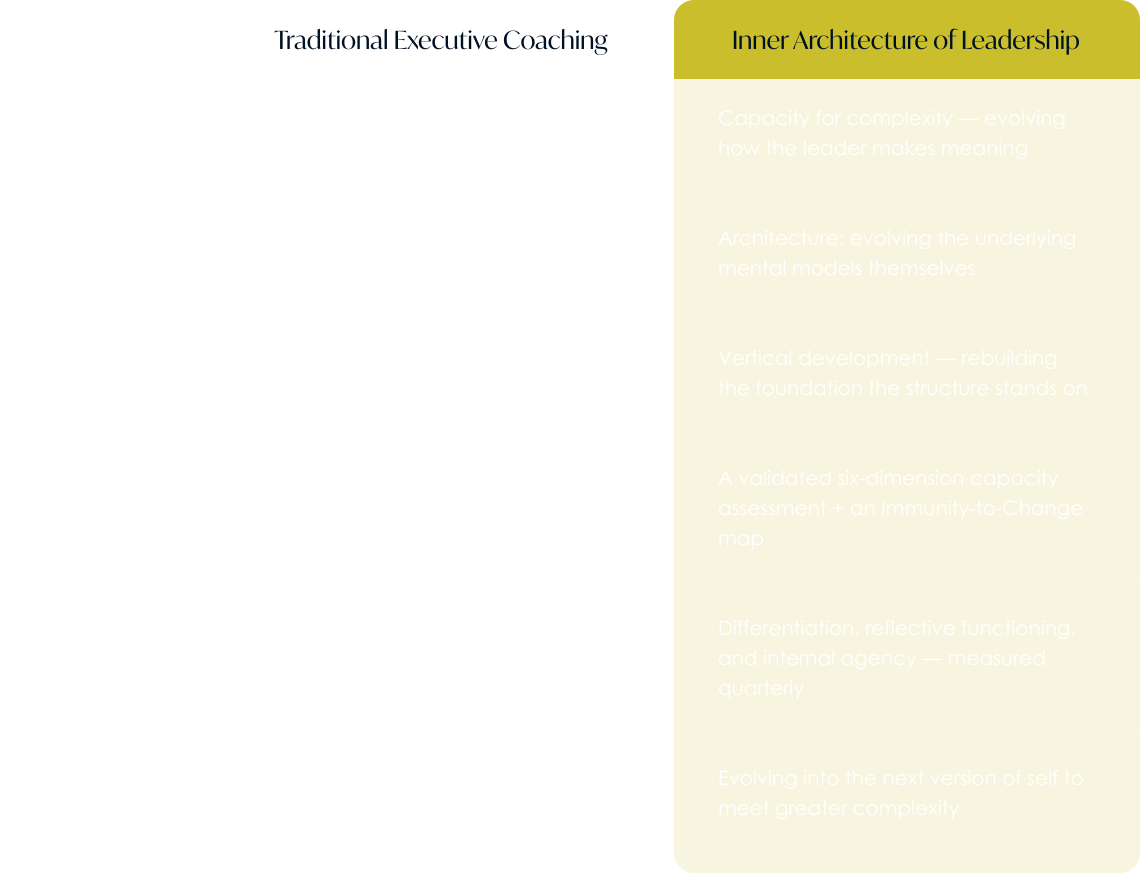
The demands on senior leaders have outpaced what skill acquisition can solve. Complexity, ambiguity, and the pace of change now regularly exceed what a leader's current stage of mind was built to hold.
Most executive coaching adds rooms to the house. IAL asks a different question: what if the issue isn't the rooms — it's the foundation they're standing on?
Kegan and Lahey's research at Harvard found that highly capable, motivated leaders remain stuck against their own goals — not from lack of skill or willpower, but because a hidden, self-protective commitment is quietly working against the change they say they want.
IAL is built to surface and dissolve that hidden immune system. Not to add another framework on top of it.
What Makes This Different
Horizontal skills vs. vertical development

The Living Well Capacity Model
Four pillars. Every module maps back to one.

Somatic Regulation
The ability to remain centered in Self — rather than in an activated part — in high-stakes moments. Measured via the Nervous System dimension.

Cognitive Agility
The capacity to hold paradox, tolerate ambiguity, and revise long-held mental models under pressure. Measured via Leadership and Identity dimensions.

Internal Authority
Operating from an internal locus of control and existential mission — rather than external validation or inherited role. Measured via the Values dimension.

Relational Depth
The capacity for deep attunement and secure relational blueprints — in the marriage, the boardroom, and across the org. Measured via Attachment and Relationships.

Is This for You?
Good fit for individuals who…

Somatic & Relational Foundation
"Is the world safe? Am I lovable?"
The nervous system learns regulation through co-regulation. Emotions and body sensations are the self — no observer yet. Attachment patterns are established here, and trauma can arrest development at this stage.

Relational / Belonging Self
"Do I belong? Am I acceptable?"
Identity forms through others' expectations and approval. Boundaries are thin; the self is made of its relationships. Under pressure, many otherwise senior leaders drop here — reacting from the age they were hurt.

Emerging Individuation
"Who am I apart from others' expectations?"
Values begin separating from absorbed family and cultural norms. Anger surfaces as a vehicle for differentiation. Identity experiments are tentative but genuine.

Self-Authored Identity
"What do I truly believe, value, and want?"
Secure differentiation: the leader can be known and still be loved. Internal authority replaces the need for external validation. Secure boundaries and genuine self-leadership emerge here.

Interdependent & Integrated Self
"How do I live in full contribution and mutual relationship?"
Identity becomes fluid and comfortable being revised by experience. Full autonomy and deep connection are not opposites. Generativity, paradox tolerance, and integrated legacy characterize this stage.

Program Structure
Four concurrent tracks. Nine to twelve months.
Biweekly · 60–90 minutes
1:1 Coaching Sessions
Individual sessions with Steve — the primary relational container for the work. Weekly cadence during the foundational modules and during any intensive developmental period.
Monthly · 90–120 minutes
Cohort Mastermind
A small group of 5–12 senior leaders at similar developmental stages. The mastermind is where relational theory meets relational practice — with peers who understand the terrain.
Daily · 10–20 minutes self-directed
Daily Capacity Training
Morning nervous-system regulation, structured journaling, and breathwork. Development happens in between sessions — not only during them.
Intake · then quarterly
Assessment & Measurement
A six-dimension Executive Capacity Assessment at intake, Day 30, Day 90, Day 180, and completion. Progress is tracked dimension-by-dimension, not as a single composite score.
Program Structure
Real-world challenges between sessions
Structured stretch assignments — White, Yellow, Blue, Brown, and Black Belt — that carry the curriculum into live leadership situations. Development without application is theory.





The Curriculum
Ten modules. One developmental arc.
Modules 1–4 build the somatic and relational foundation — they are rarely reordered. Modules 5–10 flex to your presenting edge.

Identity
Purpose
Redefine the self beyond the Hero or Perfectionist role. Surface the family blueprint that shaped what was "OK" and what got exiled — and begin reclaiming the unclaimed energy.

Attachment
Connection
Decode the relational blueprint of your leadership. Map how an old family dynamic is being re-enacted in the boardroom — with people who never signed up to play that role.

Nervous System
Presence
Polyvagal mastery and recovery speed. Build the window of tolerance, develop real-time regulation tools, and examine the coping patterns that are borrowing against tomorrow's baseline.

Mastery — Parts Integration
Flexibility
Integrate the competing internal "parts" that run your leadership under pressure. Work with the Inner Boardroom — and get curious about what each part is actually protecting.

Adult Development
Flexibility
The conceptual hinge of the program. Facilitate a Subject-Object shift — so you can have your experience rather than be it — and run your first Immunity-to-Change experiment.

Values & Purpose
Purpose
Translate actual values — not aspirational ones — into a durable reference point for every boundary, decision, and leadership tradeoff that follows.

Relationships
Connection
Extend the relational work into every domain that matters — the marriage, the exec team, the board, direct reports. Name the repeating rupture pattern and interrupt it consciously.

Leadership
Flexibility
Separate Creative Competencies from Reactive Tendencies — the patterns that emerge under pressure and extract a quiet cost from the people around you.

Embodiment
Presence
Anchor the developmental shifts in the body — not just in narrative insight. Somatic integration, daily regulation practice, and the Black Belt challenge.
Embodiment

Legacy
Purpose
Draft the Legacy Statement. Build the Integration Portfolio. Transition into the alumni mastermind. Name — in one sentence — the impact you want to have been true.
Embodiment

Before the Work Begins
A six-dimension assessment. Nothing is generic here.
Every IAL engagement opens with a structured diagnostic across six dimensions — producing two concrete artifacts: a Personalized Capacity Map and an Immunity-to-Change Map. Nothing in the curriculum begins until this diagnostic is complete.
Dimension 1
Nervous System
Autonomic Ladder mapping, a two-week Triggers & Glimmers inventory, Window of Tolerance self-rating, and the Reward & Regulation Screener — a domain scan of what you reach for under load.
Dimension 2
Leadership
Self-survey plus a structured rater survey sent to 5–8 stakeholders — direct reports, peers, board members, partner. Aggregated confidentially. Separates Creative Competencies from Reactive Tendencies.
Dimension 3
Attachment
Self-report on the two validated axes of adult attachment — anxiety and avoidance — plus an AAI-informed Attachment Narrative Interview and a Relational Pattern Timeline across your career.
Dimension 4
Identity
A 60–90 minute structured interview — adapted from Kegan's Subject-Object Interview — designed to surface the invisible scripts early conditioning installed in your nervous system.
Dimension 5
Values
A ranked values inventory with satisfaction scoring. Any value rated below 7 flags an area being tolerated rather than addressed — and becomes priority material for Module 6.
Dimension 6
Relationships
An honest read on the health of the relational structures you depend on — partner, exec team, board, direct reports — before those structures show up as case material mid-program.
Program Structure
Personalized Capacity Map
Answers five questions: your current stage of adult development, what drives your nervous system under pressure, the protective patterns showing up in your leadership, which of the four capacities is most underdeveloped, and what you're specifically protecting by staying where you are.

The Deliverables
Immunity-to-Change Map
Maps the four-column structure Kegan and Lahey validated at Harvard: the change you say you want, the behaviors working against it, the hidden commitment those behaviors are protecting, and the Big Assumption that makes it all feel necessary. Turns an intractable pattern into a testable hypothesis.
Who This Is For
This program is right for you if…
You are a senior leader — founder, executive, or partner — who has already built significant external success
You can identify the pattern you want to change — and have already tried to change it more than once
You're ready to bring the same rigor to your inner life that you've brought to your craft
You can commit 9–12 months to structured developmental work — with accountability between sessions
You've hit a ceiling that more knowledge, more strategy, or more hustle hasn't been able to move
Your leadership is affecting the people around you in ways you're willing to look at honestly
You want to understand how your early relational history is running your present-day leadership
You want your leadership and your inner life to be in integrity with each other
A note on readiness: IAL is a coaching program, not psychotherapy. For leaders whose nervous system assessment surfaces material that exceeds the scope of coaching — active trauma responses, significant dysregulation, acute mental health concerns — a referral pathway to appropriate clinical support is built into the program from intake. This is not a barrier to participation; it is part of how we take your development seriously.

You've outgrown what skill-based coaching can deliver
The demands on senior leaders have outpaced what skill acquisition can solve. Complexity, ambiguity, and the pace of change now regularly exceed what a leader's current stage of mind was built to hold.
Most executive coaching adds rooms to the house. IAL asks a different question: what if the issue isn't the rooms — it's the foundation they're standing on?
"The self is not a fixed structure — it is an ongoing construction shaped by experience, relationship, and meaning. Development is the process of expanding one's capacity to be in relationship with others, with emotions, and with oneself."
Program Foundation


Steve Thorpe, LCPC
Steve is a Licensed Clinical Social Worker and the founder of Living Well Psychotherapy and Coaching. He has spent more than two decades working at the intersection of relational trauma, adult development, somatic intelligence, and high-stakes leadership.
IAL draws directly on the same theoretical foundations as his clinical work — IFS, attachment theory, polyvagal-informed somatic practice, and constructive-developmental psychology — translated from the therapy room into the executive suite.
His approach is relational, rigorous, and grounded in the conviction that a leader's inner architecture shapes everything their organization becomes.
Apply for the Program
Enrollment is by application and conversation
IAL is a small cohort program. A brief application allows Steve to understand where you are and whether this is the right moment and the right container for the work you're ready to do.
Submitting this form begins a conversation — not a commitment. Steve will follow up personally to schedule a call and explore whether this is the right fit.
Some healing needs community to complete it.
Reach out to learn about current groups, upcoming intensives, and whether a spot is right for you. All groups are small and carefully curated.

Copyright © Living Well Coaching 2026. All Rights Reserved


